
🍲 Hamburger Vegetable Soup: A Microbiome-Supportive Comfort Classic
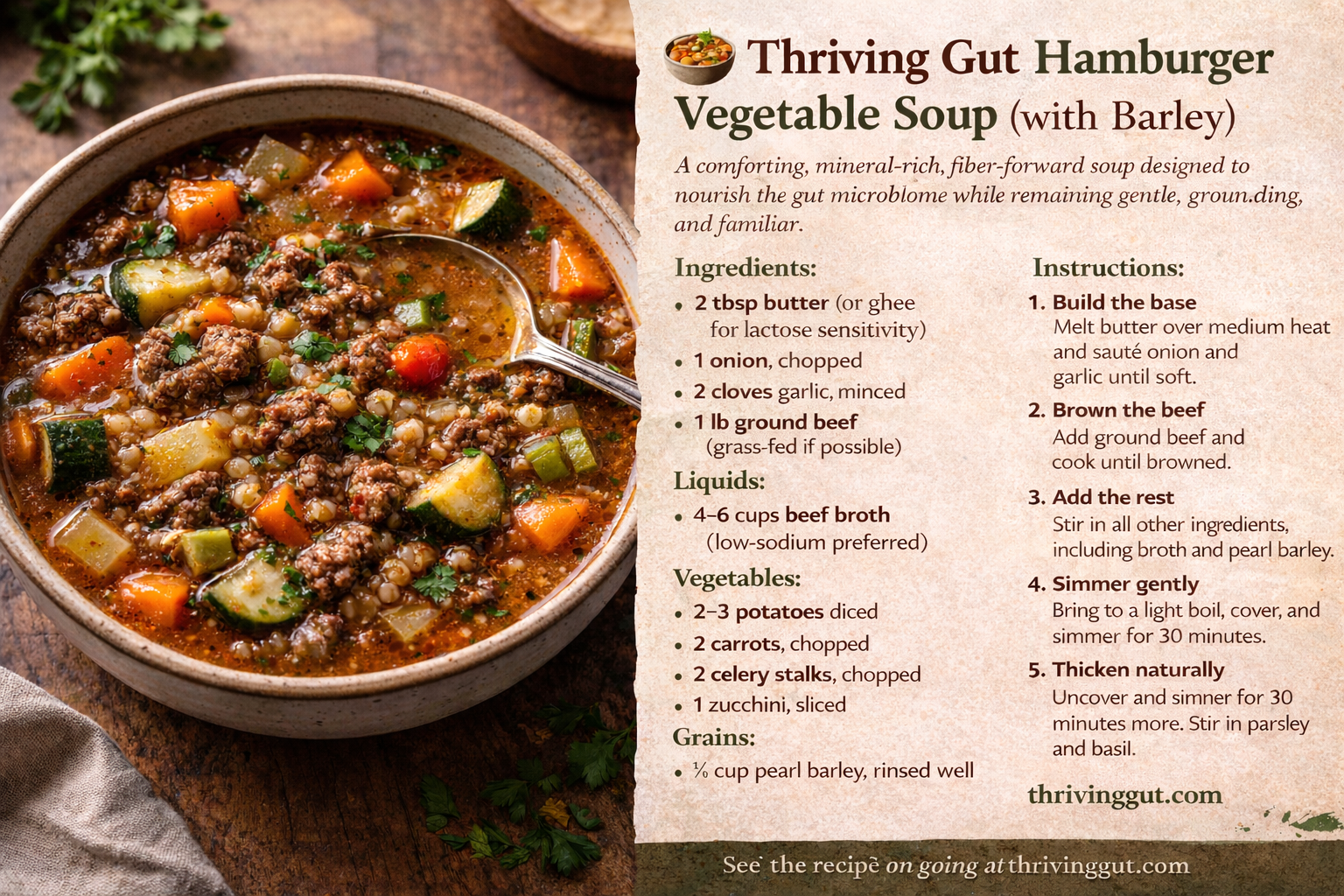
Bowl of Hamburger Vegetable Soup
Introduction
At Thriving Gut, we approach recipes the same way we approach health: food as information. Every ingredient sends signals to the gut microbiome, influencing inflammation, immune tone, metabolic health, and even mood through the gut-brain axis.
This Hamburger Vegetable Soup is intentionally simple, slow-cooked, and familiar, yet strategically designed to support microbial diversity, gut barrier integrity, and resilience during stress, illness, or recovery.
This is not “healthy food” for the sake of restriction.
It’s functional comfort food, built with purpose and ease.
🥕 The Hamburger Vegetable Soup Recipe (with Barley)
(Thriving Gut adaptation from Nicole’s Dad’s soup; makes ~6 servings)
Ingredients
Base
2 tbsp butter (or ghee for lactose sensitivity)
1 onion, chopped
2 cloves garlic, minced
1 lb ground beef (grass-fed if possible)
Liquids
1 (28 oz) can diced tomatoes
4-6 cups beef broth (low-sodium preferred)
Vegetables
2–3 fresh potatoes, diced
2 carrots, chopped
2 celery stalks, chopped
1 zucchini, sliced
Grains
½ cup pearl barley, rinsed
Herbs & Seasoning
3 tbsp parsley (fresh or dried)
½ tsp basil
Black pepper, to taste
Optional: pinch of sea salt
Instructions
Build the base
Melt butter over medium heat. Add onion and garlic; sauté until soft and fragrant.Brown the beef
Add ground beef, breaking it apart. Cook until just browned. Drain fat.Layer the fiber and nutrients
Add tomatoes, broth, potatoes, carrots, celery, zucchini, and barley.Simmer gently
Bring to a light boil, reduce to a gentle simmer. Cover and cook 30 minutes.Thicken naturally
Uncover and simmer another 30 minutes until barley is tender.Finish
Stir in parsley, basil, and pepper. Taste and adjust seasoning.
🌿 Gut Microbiome Benefits of Key Ingredients
🧄 Onions
Onions are rich in inulin and fructooligosaccharides (FOS), prebiotic fibers that selectively feed Bifidobacterium and Lactobacillus. These microbes produce short-chain fatty acids (SCFAs), which strengthen the gut barrier and regulate inflammation.
Benefit: Onion intake has been shown to positively modulate gut microbial composition and metabolite production (Kocot et al., 2022 and Yoo et al., 2024).Supports microbial diversity and enhances anti-inflammatory pathways. Prebiotic fuel, microbial diversity, gut barrier support.
🧄 Garlic
Garlic contains inulin-type fructans and sulfur compounds (including allicin) that act as selective antimicrobials—suppressing pathogenic bacteria while supporting beneficial species.
Benefit: Garlic consumption has been linked to improved gut microbiota profiles and cardiometabolic markers (Ried, 2020). Boosts immunity, lowers blood pressure, and supports microbiota diversity. Immune modulation, microbial balance.
🥩 Ground Beef
Protein provides essential amino acids for gut lining repair, immune function, and neurotransmitter synthesis. When paired with fiber (as in this soup), protein fermentation shifts away from harmful byproducts. Grass-fed beef also supplies zinc, iron, and B vitamins critical for mucosal immunity.
Benefit: Adequate protein intake supports epithelial integrity and immune resilience (Kocot et al., 2022). Structural repair, immune support.
🌾 Pearl Barley
Barley is a standout microbiome ingredient due to its beta-glucan content—a fermentable fiber strongly associated with increased SCFA production, reduced inflammation, and improved metabolic health.
Benefit: Beta-glucans from barley consistently increase beneficial gut bacteria and SCFA synthesis (Leeming et al., 2019) and a key to anti-inflammatory metabolic signaling (Armour eet al., 2019).
🥔 Potatoes
Potatoes provide fermentable starch, especially when cooled and reheated, increasing resistant starch content. Resistant starch feeds butyrate-producing bacteria that support colon health.
Benefit: Resistant starch improves insulin sensitivity and gut microbial diversity (Leeming et al., 2019). Butyrate production, metabolic support.
🥕 Carrots
Carrots contain soluble fiber and polyphenols that support SCFA production and reduce oxidative stress in the gut.
Benefit: Vegetable-derived fibers improve microbial diversity and intestinal health (Armour et al., 2019). Anti-inflammatory fermentation substrate.
🌿 Celery
Celery provides soluble fiber and polyphenols that support microbial balance and hydration of stool, improving gut motility.
Benefit: Polyphenol-rich vegetables are associated with beneficial shifts in gut microbiota (Yuan et al., 2021). Motility support, microbial balance.
🥒 Zucchini
Zucchini is low-FODMAP, gentle, and rich in water-soluble fiber—ideal during digestive stress or microbiome resets.
Benefit: Low-fermentation vegetables reduce GI stress while maintaining fiber intake (Leeming et al., 2019). Gentle fiber, digestive ease.
🌿 Parsley & Basil
Herbs contain polyphenols that modulate gut bacteria and reduce oxidative stress.
Benefit: Culinary herbs support microbial balance and anti-inflammatory pathways (Yuan et al., 2021). Polyphenol signaling, microbial modulation.
❤️ Food, Stress, and the Gut–Brain Axis
When Nicole cooks her dad’s Hamburger Soup, I’m sure she’s always thinking about him. This recipe always makes me think of my dad’s meatball soup and it is as much about how it’s prepared as what’s in it. When I make this recipe, I think about about Nicole and her dad, and my dad too. Both our dad’s have passed, but cooking meals they made and loved, brings warmth into my kitchen.
Slow cooking, familiar aromas, and warm meals activate the parasympathetic nervous system, improving digestion and reducing cortisol, a known disruptor of gut barrier integrity.
Shared meals and mindful preparation further enhance gut-brain signaling (Leeming et al., 2019).
💪 Amplify the Impact (Thriving Gut Style)
⏰ First Meal After a Fast
Ideal as a first meal after a 14-16 hour intermittent fast-gentle fiber + amino acids support microbial re-feeding without glucose spikes.
🔁 Microbiome Reset
Use 2–3 times per week during:
A microbiome boost or reboot
High stress
Illness or recovery
Poor sleep or travel
🌱 Fermented “Sidecar”
Serve with a small spoon of sauerkraut or fermented carrots on the side, not in the pot, preserves live microbes and allows self-titration.
⚠️ Ingredient Integrity Matters
Choose low-sodium broth or a homemade bone broth to avoid excess salt
Avoid ultra-processed bouillon cubes
Cooling and reheating enhances resistant starch
Adjust garlic/onion for personal tolerance (n of 1 always wins)
🌎 Final Thought
This hamburger soup isn’t about chasing gut perfection.
It’s about lowering friction, supporting resilience, and letting simple, familiar food do powerful work - quietly, consistently, and compassionately.
Your gut doesn’t need extremes.
It needs signals it understands.
📚 References (APA)
Armour, C. R., Nayfach, S., Pollard, K. S., & Sharpton, T. J. (2019). A metagenomic meta-analysis reveals functional signatures of health and disease in the human gut microbiome. Genome Biology, 20(1), 18. https://pubmed.ncbi.nlm.nih.gov/31098399/
Kocot, A. M., et al. (2022). Overview of the importance of biotics in gut barrier integrity. International Journal of Molecular Sciences, 23(5), 2552. https://pubmed.ncbi.nlm.nih.gov/35270039/
Leeming, E. R., Johnson, A. J., Spector, T. D., & Le Roy, C. I. (2019). Effect of diet on the gut microbiota: Rethinking intervention duration. Nutrition Research Reviews, 32(2), 179–193. https://pubmed.ncbi.nlm.nih.gov/31766592/
Ried, K. (2020). Garlic lowers blood pressure, improves arterial stiffness and gut microbiota: A meta-analysis. Experimental and Therapeutic Medicine, 19(2), 1472–1478. https://doi.org/10.3892/etm.2019.8374
Yoo, Y., et al. (2024). The prebiotic potential of dietary onion extracts: Shaping gut microbial structures and promoting beneficial metabolites. mSystems, 9(1), e01189-24. https://doi.org/10.1128/msystems.01189-24
Yuan, X., Chen, R., Zhang, Y., & Zhang, Y. (2021). Emerging trends in gastrointestinal microbiome research. Frontiers in Microbiology, 12, 685058. https://pubmed.ncbi.nlm.nih.gov/34332587/
